 3, Power Plant Choices
Home Page Sitemap About Foreword Oil 2.0 Cheaper Than Coal? The Technology Footnotes & Links
StoppingClimateChange.com
3, Power Plant Choices
Home Page
Sitemap
About
Foreword
Oil 2.0
Cheaper Than Coal?
The Technology
Footnotes & Links
Site Facilities: 1 Unneeded Old Coal Power Plant
2 New Power Plant
Building
Power Plant: 3 Power Plant Choices:
3a Pilot Plant Power Drop
3b Carbon Capture Power
REACTORS:
3c GA 1,560°F
3d NuScale 550°F
3e ThorCon 1,300°F
3f Terrestrial 1,300°F
Fuel Feedstock:
4 Hydrogen and Steam
Generators 5 Biomass Preparation
6 Plasma Torch Biomass Gasifier
Refinery: 7 Biosynfuel Refinery
8 Biosynthetic Fuels
8a Cellulosic E85 BioEthanol
8b Cellulosic M70 BioMethanol
8c Cellulosic BioDiesel
8d Green Hydrogen
POWER PLANT CHOICES
An excellent introduction to advanced nuclear
reactors may be obtained from chapter 3 (Advanced Reactor Technology Evaluation)
of the recently-released MIT study:
"The Future of Nuclear Energy in a Carbon-Constrained World" (pdf). This is as
close to a "Consumer Reports" report as you will ever get.
This paper's 2018 guidance can be seen in this web page's date sequence.
________________________________________________________________
Non-nuclear Power Plants
When:
NOW
3a Pilot Plant - To Power A 1/5 Scale Carbon-neutral Fuel
Manufacturing Technologies Plant To Optimize Facilities 4, 5, 6, 7, 8
(For grid powered pilot plant, use the existing coal plant grid connection
substation in reverse to supply grid level electricity to the energy park pilot
plant)
(One must pretend the electricity used by the pilot plant was made by a nuclear
reactor, wind farm, or solar garden elsewhere that is attached to the same grid
as the pilot plant.)
________________________________________________________________
When: NOW 3b Non-nuclear Carbon Captured Fossil Fuel Powered Plant
(90% carbon capture from jet engine exhausts is no easy thing to make happen. It may prove to be safer, easier, and cheaper to use small TRISO nuclear reactors.)
Not all the modern studies of Molten Salt Reactor
component behavior have been completed yet - at least another decade will be
needed - and it would be relatively easy,
quicker, and far less costly to get an
equally or more powerful natural gas powered carbon captured combined cycle gas
turbine package unit with natural gas exhaust carbon capture columns and CO2
compressors added.
It must be pointed out that natural gas turbine exhausts have substantially less
CO2 per cubic meter to capture than coal so the carbon capture columns are going
to be big sheet metal silos.
Also, the steam turbine+electricity generator would be deleted and the Heat
Recovery Steam Generators (HRSGs) become Heat Recovery Solar Salt Heaters
(HRSSH) for process heat transport instead.
As an 80-year old engineer whose name is on a few electrical drawings for a 1958 "sodium cooled advanced reactor", it looks like writing a carbon captured twin gas turbine purchase order is the way to go until about 2025.
Carbon capture vs. nuclear. The world could have, and should have, begun moving away from fossil fuels as early as the 1950s. Now decarbonizing has become an urgent necessity. It is unlikely that it will be possible to quickly obtain production versions of the small nuclear reactors listed below before 2035. On the other hand, several post-combustion gas turbine carbon capture designs have been published. They are ready for detailed site construction drawings and cost estimates for a pair of currently marketed mass-produced 50 megaWatt or larger power plant natural gas turbines and their associated electricity generators. The carbon capture equipment could consume as many as 4 acres of plant site.
Natural gas prices should continue to reflect the
increasing downward pressure being brought to bear on all fossil fuels.

CO2 disposal. Some of the unneeded coal power plant sites that could be considered to be in acceptable configuration and condition for upgrading to a Clean Energy Park happen to be located directly above underground strata considered an excellent CO2 disposal site. Since safe CO2 disposal can be achieved at these locations by simply drilling a CO2 disposal well on site property, CO2 disposal couldn't be safer, easier, or cheaper.
Bottom Line: For now, you'll get more electricity and heat for your dollar with a pair of natural gas turbines connected to an integral carbon capture system (below).
Integral Carbon Capture

This also brings up the issue of what kind of fossil fuel philosophy is best for this kind of application.
________________________________________________________________
Small Modular Reactors (SMRs)
When: ANY TIME
3c General Atomics SiGA™ EM2 Underground Nuclear Reactor 1,560°F Hydrogen Gas
Cooled TRISO
http://www.ga.com/advanced-reactors
A Better Nuclear Waste Plan
>
A TRISO-fueled, hydrogen gas cooled small reactor.
Many versions of these reactors - both "pebble bed" and "prismatic" - have been
built and run in the past with little trouble.
China is currently serial manufacturing their HTR-PM TRISO reactor for an electricity generating
complex on their East coast.
https://www.sciencedirect.com/science/article/pii/S2095809916301552
The temperatures developed by these types of reactors are very conducive to
powering Skyscrubbers and Thermochemical Hydrogen Generators.
________________________________________________________________
When: 2022+
3d NuScale Underground Nuclear Reactor 550°F
Conventional Water Cooled
http://www.nuscalepower.com/
A Better Nuclear Waste Plan
>
NuScale is a "Bridge" technology between your grandfather's
nuclear reactors and your children's nuclear reactors. Consider the differences
between piston engines and jet engines.
(Below: 5 several minute youtube videos about The NuScale
Reactor - the first of the next generation nuclear reactors - currently under
construction at Idaho National Laboratories.)
1. NuScale website introduction video:
https://www.youtube.com/watch?v=Quw5rC5Vcfc&feature=youtu.be
2. Explaining how the NuScale reactor
works and how it is different from your grandfather's first early 1950's
reactors:
https://www.youtube.com/watch?v=tiXYe4RTgQE
3. Jose Reyes, NuScale
Technology Officer, Comments:
https://www.asme.org/engineering-topics/media/energy/video-small-modular-nuclear-reactors
(youtube)
4. Identifying A NuScale reactor's main components:
https://www.youtube.com/watch?v=F9tmn9LYGjQ
5. Assembling the NuScale's main reactor power module components in the common
coolant pool:
https://www.youtube.com/watch?v=wDMsXEur1fs
________________________________________________________________
When:
2030+
3e ThorCon Underground Nuclear Reactor 1,300°F Molten Salt
Cooled
http://thorconpower.com/
A Better Nuclear Waste Plan
>
When:
2035+
3f Terrestrial Energy Underground Nuclear Reactor 1,300°F Molten Salt
Cooled
https://www.terrestrialenergy.com/
A Better Nuclear Waste Plan
>
________________________________________________________________
NuScale is a U.S. Light Water Reactor (LWR) (conventional reactor), 50 megaWatt(e) Extra Safe "Bridge"
Reactor.
ThorCon, U.S. company, designed it's dual 250 megaWatt(e) modules to be fabricated in Korean automated
shipyard, the first unit to be assembled and run in Indonesia, is based on the 1965 8 megaWatt Oak
Ridge Molten Salt that ran uneventfully for about 5 years. ThorCon thinks the
Nuclear Regulatory Commission might have done a better job in the past.
Terrestrial Energy (Canada) 190 megaWatt(e)
General Atomics (U.S.) has been doing very leading-edge reactor development
since 1960. 265 megaWatt(e). Many university teaching reactors came from GA.
Like NuScale, this reactor technology has been around since almost the
beginning. An early version of it was used to power the Ft. St. Vrain plant in
Colorado. It was considered so safe the Nuclear Regulatory Commission said a
containment building was unnecessary. It is the hottest of the nuclear
technologies and ideal for thermochemical production of the hydrogen gas needed
to power a hydrogen economy.
http://www.fsvfolks.org/
https://en.wikipedia.org/wiki/Fort_St._Vrain_Generating_Station
http://ansnuclearcafe.org/2018/02/14/fort-st-vrain-in-pictures-2
Too small to power a Clean Energy Park, but not too small to replace diesel generators, ship, industrial, or heating boilers, nuclear is becoming even more advanced.

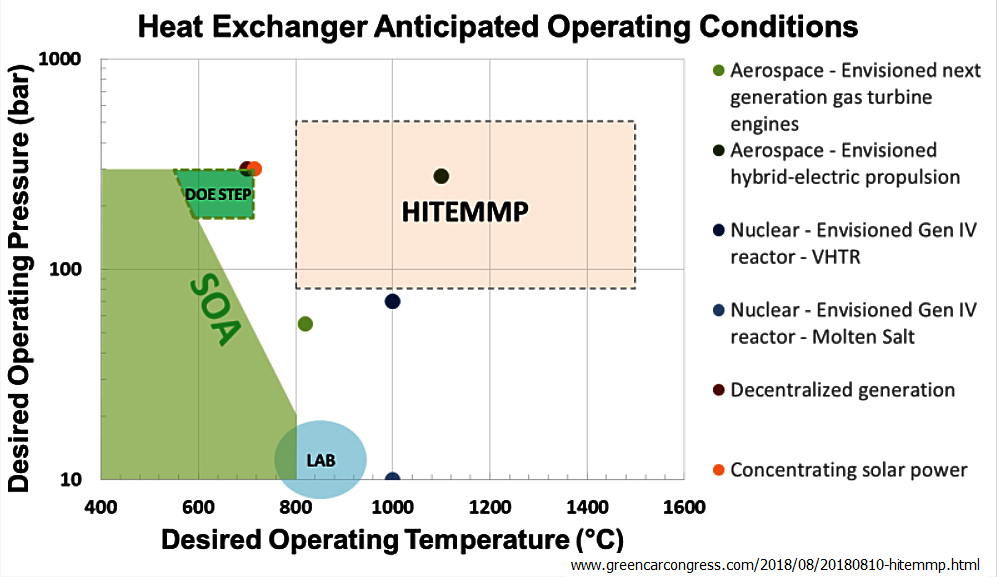
https://analysis.nuclearenergyinsider.com/
http://www.greencarcongress.com/2018/08/20180810-hitemmp.html
Nuclear Energy Websites Future Application Operating Temperatures
Kilopower:
https://en.wikipedia.org/wiki/Kilopower
eVinci:
http://www.westinghousenuclear.com/New-Plants/eVinci-Micro-Reactor
OKLO:
https://www.nrc.gov/reactors/new-reactors/advanced/oklo.html
Holos Gen:
http://www.holosgen.com/
Information about new small reactors: http://www.world-nuclear.org/information-library/nuclear-fuel-cycle/nuclear-power-reactors/small-nuclear-power-reactors.aspx
International Atomic Energy Agency: https://www.iaea.org/
U.S. Nuclear Regulatory Commission: https://www.nrc.gov/about-nrc/history.html
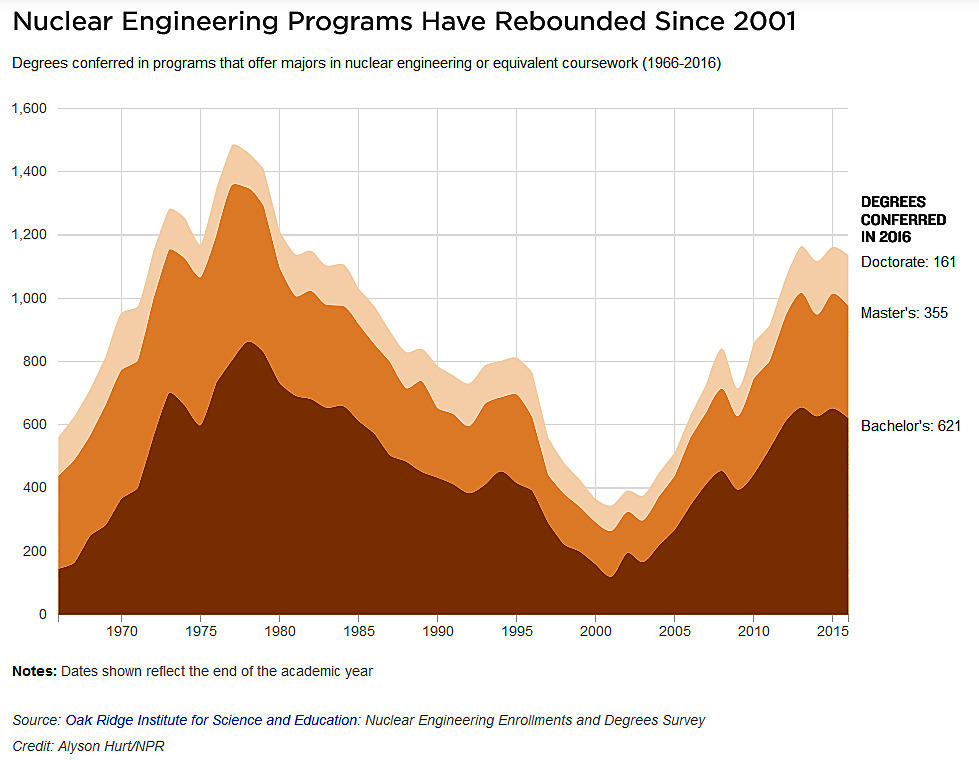
A lot of tech-savvy millennials have seen through the wishful thinking surrounding using only wind and solar energy to power mankind's future.
 Items and issues extracted from the above Canadian report:
SMALL MODULAR REACTORS UNDER DEVELOPMENT - These categories are distinguished primarily by their fuel and/or coolant properties:
1.
Pressurized Water-cooled Reactors (PWR)
(Modern SMR bridge versions of today's large water-cooled reactors.)
2.
High-Temperature Gas-cooled Reactors (HTGR)
3. Sodium-cooled Fast Reactors
(SFR)
4.
Lead-cooled Fast Reactors (LFR)
5. Gas-cooled Fast Reactors
(GFR)
6.
Molten
Salt Reactors (MSR)
7. Fusion Reactors
SMRs COULD BE APPLIED TO APPLICATIONS BEYOND ELECTRICITY:
Application Rank
OTHER ISSUES INCLUDE:
1.
Operation beyond electricity generation
2. Simple design and operation
3. Quick
deployment
4. Well understood and quantified risks
5. Reactor must be
transportable
6. Schedules must be accurate and predictable
7.
And, with the nuclear industry struggling to compete against low-cost natural gas generation, the birthplace of nuclear reactors, Idaho National Laboratories, is stepping up a search for ways to lower existing reactor operating costs, research on "accident tolerant" reactor fuels for existing water cooled reactors, i.e., developing safer fuel rod cladding than the zirconium that has been traditionally used, designing more efficient control rooms and using technology to reduce reactor safety inspection time and costs.
Small Modular Reactor (SMR) consortium: http://smrstart.org/ About SMRs: http://smrstart.org/news-and-resources/ SMR Economics
According to the American think tank Third Way,
there are presently five SMRs in
development in the US:
Global list of Small Modular Reactors (SMRs):
http://www.uxc.com/smr/uxc_SMRList.aspx
• NuScale Power, Corvallis, Oregon
http://www.nuscalepower.com/
• Radix Power and Energy Corp, Setauket, New York
http://www.uxc.com/smr/
• Holtec, Jupiter, Florida
http://www.holtecinternational.com/productsandservices/smr/
• Westinghouse, Fulton, Missouri
http://www.westinghousenuclear.com/New-Plants/Small-Modular-Reactor
• General Atomics, San Diego, California
http://www.ga.com/energy-multiplier-module
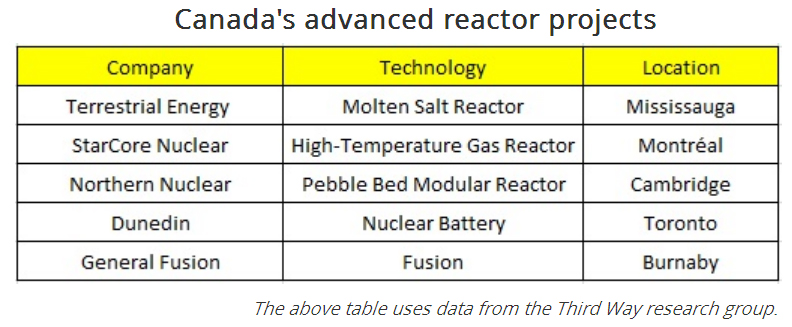
http://starcorenuclear.ca/#!/welcome/
NuScale is expected to file the first full design license application for a small modular reactor (SMR) later this year. The Oregon based developer was an early mover in the design licensing process, starting its NRC design certification pre-application project back in 2008. NuScale plans to submit its license application in late 2016 under a DoE funding agreement which will provide the firm with $217 million towards the design certification application and other commercialization engineering, analysis and testing.
NuScale is the largest single recipient of DoE funding for SMR licensing and development and the government’s support mechanism requires the group to execute testing programs in support of design development and NRC review requirements. - - - Nuclear Energy Insider, Jan 12, 2016
Large energy, no matter if it is coal, natural gas, oil, or nuclear energy, must have government licensing. Example: Boiler License Example - Permit Extract - Los Angeles .pdf
How nuclear energy can be used to replace fossil fuel energies

