 4,
Hydrogen and Steam Generators, Desalinator
Home Page Sitemap About Foreword Oil 2.0 Cheaper Than Coal? The Technology Footnotes & Links
StoppingClimateChange.com
4,
Hydrogen and Steam Generators, Desalinator
Home Page
Sitemap
About
Foreword
Oil 2.0
Cheaper Than Coal?
The Technology
Footnotes & Links
Site Facilities: 1
Unneeded Old Coal Power Plant
2 New Power Plant
Building
Power Plant: 3 Power Plant
Choices 3a Pilot Plant Power Drop
3b Carbon Capture Power
REACTORS:
3c GA 1,560°F
3d NuScale 550°F
3e ThorCon 1,300°F
3f Terrestrial 1,300°F
Fuel Feedstock:
4 Hydrogen and Steam
Generators 5 Biomass Preparation
6 Plasma Torch Biomass Gasifier
Refinery: 7 Biosynfuel Refinery
8 Biosynthetic Fuels
8a Cellulosic E85 BioEthanol
8b Cellulosic M70 BioMethanol
8c Cellulosic BioDiesel
8d Green Hydrogen
Hydrogen and Steam Generators, Desalinator
The Hydrogen Economy
Journal Items


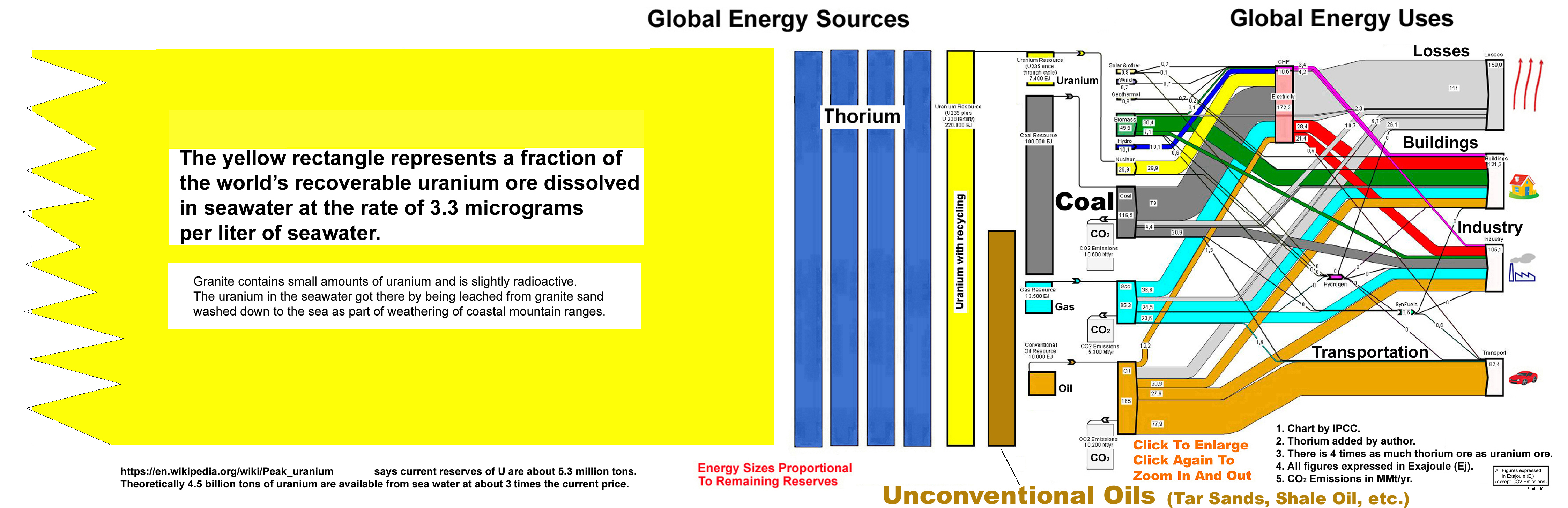
The amount of energy available to produce Hydrogen using the Nuclear Thermochemical process. (Click to Enlarge. Click again to zoom in and out.)

Thermochemical cycles combine solely heat sources (thermo) with chemical reactions to split water into its hydrogen and oxygen components. The term cycle is used because aside from water, hydrogen and oxygen, the chemical compounds used in these processes are continuously recycled. If electricity is partially used as an input, the resulting thermochemical cycle is defined as a hybrid one.
The sulfur-iodine cycle (S-I cycle) is a thermochemical cycle processes which generates hydrogen from water with an efficiency of approximately 50%. The sulfur and iodine used in the process are recovered and reused, and not consumed by the process. The cycle can be performed with any source of very high temperatures, approximately 950 °C, such as by Concentrating solar power systems (CSP) and is regarded as being well suited to the production of hydrogen by high-temperature nuclear reactors, and as such, is being studied in the High Temperature Test Reactor in Japan. There are other hybrid cycles that use both high temperatures and some electricity, such as the Copper–chlorine cycle, it is classified as a hybrid thermochemical cycle because it uses an electrochemical reaction in one of the reaction steps, it operates at 530 °C and has an efficiency of 43 percent.
Source of extreme high temperature, high wattage, industrial
electric heating elements
https://www.kanthal.com/en/

(Above) A ThorCon dual reactor installation is good for 250 +
250 megaWatts maximum. Not all that big when you consider the heat load
presented by
chemical water splitting and energy needed to control catalytic hydrocarbon molecule
joining. Fortunately, both hydrogen and oxygen can be stored for later use.
See below to get an idea of how heat flows inside and between fuel molecules
while burning.
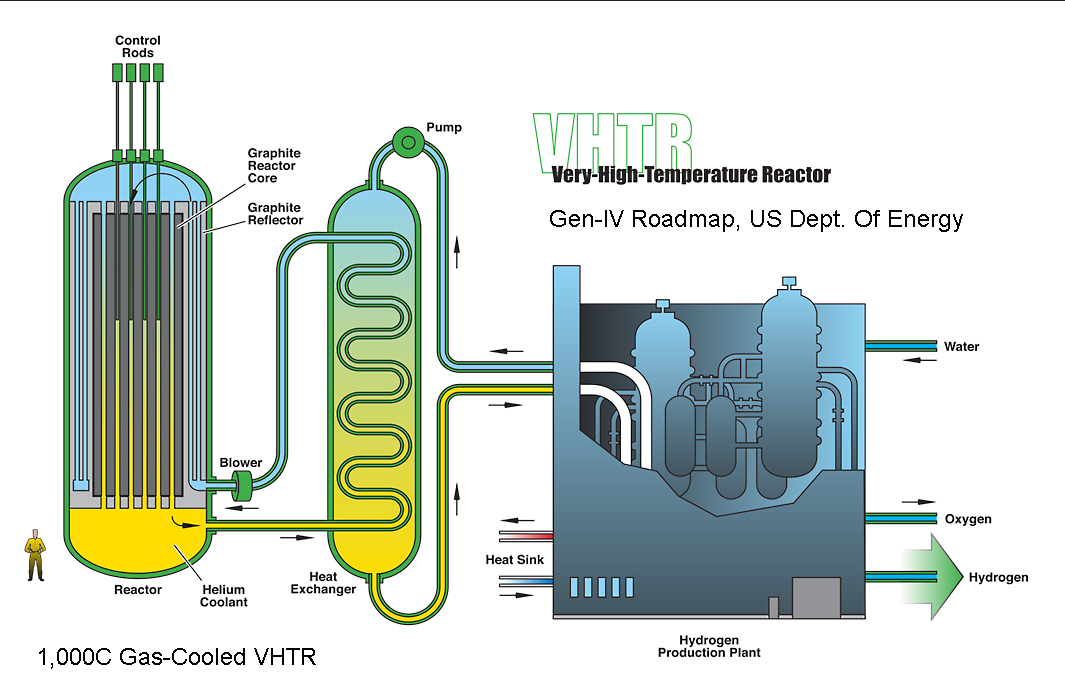
Gas-to-Molten Salt Liquid heat transmission system.
Nuclear Steam Generator
The NuScale is a "bridge" reactor, having aspects of both third and fourth generation reactors. It is a 50 megaWatt(e) conventional 550°F, water cooled reactor. Not really enough heat or power to do much beyond take an Energy Park beyond it's pilot plant stage. Additional NuScale 50 mW(e) reactors can be added to an initial NuScale site at modest cost but it would take 10 to match the electrical output of a ThorCon pair and they would be still be limited to 500°F, way below the maximum temperature demand of a thermochemical hydrogen generator.
The ThorCon is a 500 megaWatt(e) 1,300°F, molten salt cooled reactor. Lots of heat packing a lot of power. Enough for a serious sized money-making Energy Park.
The most likely ThorCon design would be a secondary salt distribution manifold capable of sending the desalinator, hydrogen generator, and steam generator 100% of the secondary salt it is designed to need. This keeps a double buffer (fuelsalt-to-secondary salt and secondary salt-to-solar salt) between the steam, hydrogen, and desalinator loads and the fuelsalt.
The steam output system would have to be designed to accommodate both electrical generation and site heat demands.
https://en.wikipedia.org/wiki/Steam_generator_(nuclear_power)
Nuclear Flash Desalinator
How a flash distillation system works: https://en.wikipedia.org/wiki/Multi-stage_flash_distillation
Solaris Water Midstream, WaterBridge Resources LLC, and Oilfield Water Logistics - Cleaning fracking waste water in arid areas.
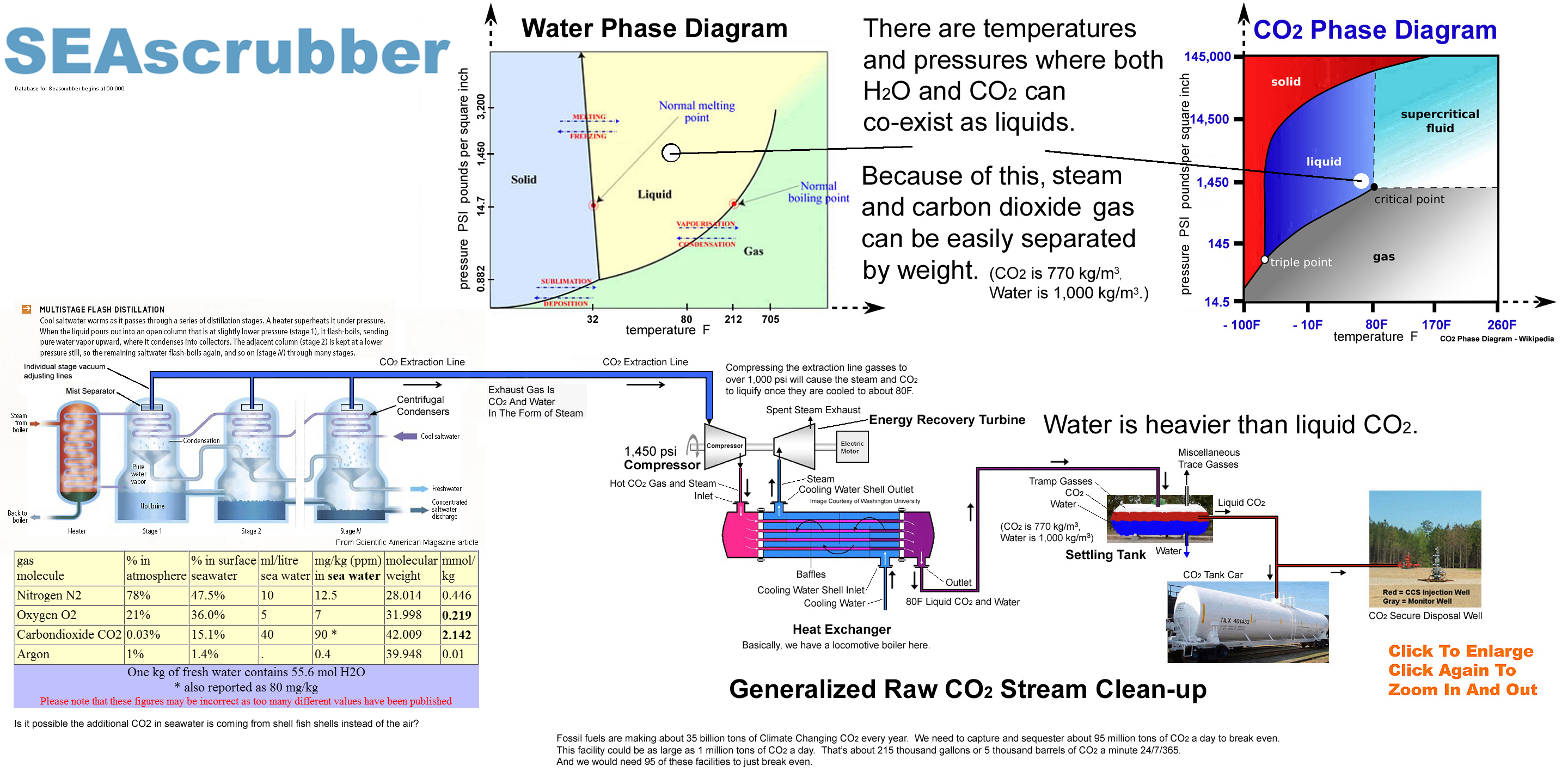
The above diagram illustrates the idea but not the machine for removing tons of CO2 per day from seawater.
The air in the first few stages of a flash distiller is rich with the CO2 that was earlier absorbed by seawater.
Massive nuclear powered cheap desalination for agricultural
purposes could both restore groundwater aquifers and reduce sea level rise.
California's central valley comes to mind. According to the table above, the
weight ratio of CO2 to seawater is 11,111 to 1.
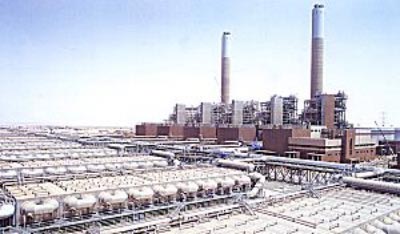
Shoaiba flash distiller and power station, Saudi Arabia.
Can consume two small oil tankers of oil per day.
This is why ThorCon's molten salt nuclear reactor is being suggested.
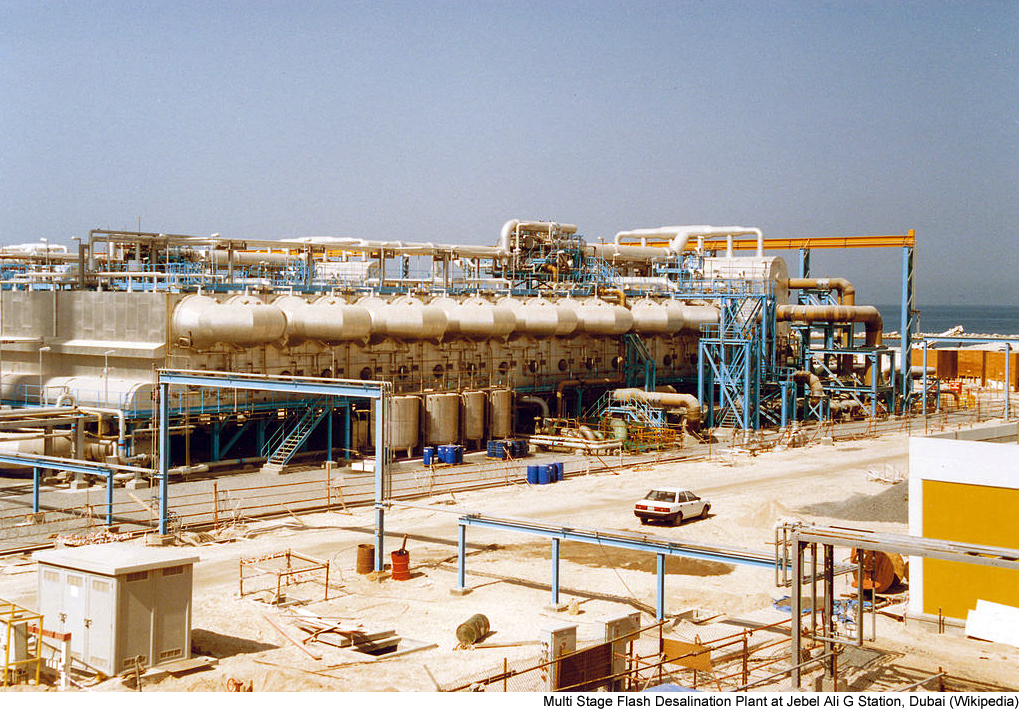
Multi-Stage Flash Desalination Plant at Jebel Ali G Station, Dubai. Notice the extensive use of tubular equipment shapes.
________________________________________________________________
This website is a draft. The candidate document's footnote numbers go with a private database. Copy the document's title and submit it to Google. The document may still be posted on the Internet.
The steam generators are clearly defined by the U.S. Nuclear Regulatory Commission, local and national building and electrical codes, and supplemented by constraints from the relevant equipment manufacturers.
The hydrogen generators are, in the size being contemplated here, relatively new territory with the material below providing some, insight on how they might be designed.
2.401 ----- Comparing Different Hydrogen Generation
Technologies
2.402 ----- US DOE - 2004 - Nuclear Hydrogen R and D Plan
2.404 ----- 10.327.06 ----- A Hydrogen Atom
2.405 ----- 15.120 -- KEY --- Hydrogen Production and
Storage - IEA 2008
2.406 ----- 19.202 ----- Hydrogen Production Breakthrough
Could Herald Cheap Green Energy
2.407 ----- 28.006 ----- US Hydrogen Policy
2.408 ----- 28.014 ----- Gaseous hydrogen -- Fuelling
stations -- Part 1 - General requirements --- ISO TS 19880-1 2016
2.409 ----- 28.018 -- KEY --- HYDROGEN as Fuel - The HTAC
Program
2.410 ----- 28.801 -- KEY -- Hydrogen as Fuel
2.411 ----- 28.802 ----- Combustion Strategies For Hydrogen
and Syngas
2.412 ----- 28.806 ----- Hydrogen from Biomethane, Gasoline
and Diesel from Tree Residue
2.413 ----- 28.806 ----- Plug Power and HyGear partner to
provide small scale SMR hydrogen production technology to fuel cell system
customers
2.414 ----- 28.808 ----- Uno-X Hydrogen to build 1st
hydrogen refueling station with hydrogen produced by surplus renewable energy
from neighboring building
2.415 ----- 28.812 ---------- HYDROGEN From Nuclear Heat
2.416 ----- 28.813 ---------- HYDROGEN GAS, - Natural
Gas,- Methane
2.417 ----- 28.814 ----- Hydrogen from Steam-Methane
Reforming with CO2 Capture
2.418 ----- 28.815 ----- Hydrogen and Synthetic
Hydrocarbon Fuels - A Natural Synergy
2.419 ----- 28.809 ----- DOE awards $14M to advance
hydrogen fuel technologies
2.420 ----- 28.802 ----- Hydrogenation of Carbon Dioxide
2.421 ----- 28.803 ----- Synthetic Gasoline from Air and
Water
2.422 ----- 28.804 ----- Storing Renewable Energy as
Clean-Burning Methane
2.423 ----- 28.805 ----- AUDI e-Gas Methane
2.424 ----- 28.807 ----- BMW is Preparing for a Hydrogen
Future
2.425 ----- 28.810 ----- Cheap and clean - Australian
company creates hydrogen with near-zero emissions
2.427 ----- 28.816 ----- Hydrogen and Synthetic Hydrocarbon
Fuels - A Natural Synergy - Slide Show
2.428 ----- 28.817 ----- Implementing the HYDROGEN ECONOMY
with Synfuels
2.429 ----- 28.818 -- KEY --- Nuclear Hydrogen
Biomass System - Slides - Charles Forsberg
2.430 ----- 28.819 -- KEY --- Nuclear Hydrogen
Biomass System - Paper - Charles Forsberg
2.431 ----- 28.820 ----- Single Pt atom catalysts show
enhanced catalytic activity for water-splitting - potential to drive down
electrolysis cost
2.432 ----- 28.821 ----- ITM Power to launch 100 MW
electrolyzer plant designs at Hannover Messe 2017
2.433 ----- 28.822 ----- New Approach to Water Splitting
Could Improve Hydrogen Production
2.434 ----- 28.823 ----- 13 global companies launch
Hydrogen Council in Davos, promoting hydrogen to help meet climate goals
2.435 ----- 28.824 ----- One of the World's largest
electrolysis plants for H2 production - EU-funded H2FUTURE
________________________________________________________________
News Notes
1. Generating it.
2. Shipping it.
3. Storing it.
4. Utilizing it.
Above from: Hydrogen Generation from Aluminum Pellets - Technical Overview.pdf
Hydrogen produces NO CO2. (Click to Enlarge. Click again to zoom in and out.)
Japanese presentation of Hydrogen's potential applications. (Click to Enlarge. Click again to zoom in and out.)