StoppingClimateChange.com  The Electricity & Hydrogen Nuke Next Door
Front Page
Contents
Prolog
About
INTRODUCTION: Attacking Climate Change From
Both Ends A Biomass Allam Cycle Power Plant The Electricity & Hydrogen Nuke Next Door Harvesting CO2 CO2
Disposal Wells Water Geoengineering
__________________________________________________________________________________________________________________________________________________
The Electricity & Hydrogen Nuke Next Door
Making the Hydrogen Economy Possible
StoppingClimateChange.com
Contents
Definitions Prolog
About
Solid Tech:
The NuScale Modular Nuclear Reactor New
Tech:
The Allam Cycle Biomass Power Plant + Harvesting CO2
+ CO2
Disposal Wells
Hydrogen Processing
Water Processing Geoengineering
Nuclear Powered Hydrogen for making Vehicle and Heating Fuels
Nuclear Powered Water Recycling and Desalination in every Town
__________________________________________________________________________________________________________________________________________________
Repowering
Coal and Gas
Electricity
Plants With Nuclear


The World's 500 cities over 1 million population and
4,000 cities over 100,000 thousand population are powered in a thousand ways
by electricity made by Coal or Natural Gas electricity generation power plants.
The fastest way to end carbonizing the
world is to electrify the top 4,500 cities with as much nuclear electricity as
possible - about 500 12 module NuScale Reactors along with 4,000 6 or 4 module
NuScale Reactor facilities.
The remainder of the world's cities, towns and villages need to be electrified
by smaller Modular Nuclear or Non-nuclear
smaller Biomass 50 to 300 mW Allam Cycle power plants to also remove the legacy CO2 from the air.
The World's Cities
Need SOLID Electricity For:
Lighting, Heating, Appliances, Automobiles, Subways
Hydrogen for making Carbon-neutral Heating Fuels, Vehicle Fuels
Water Pumping, Desalination, Wastewater Treating, Recycling
Standardized Modular Nuclear Electricity
Near Every Large City and Town
The United States has largely phased out
it's coal power plants, replacing them with hundreds of small, cleaner, natural
gas turbine power plants. Now is the time to upgrade their sites with adjacent
similar sized modular nuclear.
The world has irrevocably committed itself to a dispatchable electricity &
hydrogen powered fuel modern civilization. Only nuclear electricity generation
everywhere can satisfy such an energy demand on a forever basis.
https://energy-transitions.org/wp-content/uploads/2021/04/ETC-Global-Hydrogen-Report.pdf
-
https://www.iea.org/ , and
https://www.irena.org/
What The
World's Largest Cities Need Most: Modern Modular Nuclear Reactor Replacement
Electricity Plants

By shrinking its reactors, NuScale Power aims to
compete with wind, solar, and cheap natural gas
The stone-simple gravity-circulation NuScale Modular
Nuclear Reactor Power Plant is a very safe nuclear design to install adjacent to
our old coal or natural gas combustion turbine plants.
The reasons for adjacent choice include NuScale site size, too much existing old
power plant concrete, piping, access to the existing electrical grid, roads, rail,
workforce, and community acceptance.
This can be an inexpensive way to grow a more powerful nuclear plant as more and more
electric cars come on-line in the future. Start out buying just two reactors
and as little concrete as necessary to build the flange tool pools.
With a full complement of 12 reactor modules, it will produce 924 megaWatts of
electricity, almost twice the power of most end-of-life coal and/or natural gas turbine
power plants it is designed to replace.
2 fully populated NuScale plants placed side-to-side could produce
as much as 1,848 megaWatts of electricity. The world's most powerful single
nuclear reactor plant is TAISHAN at 1,750 mW.
https://www.youtube.com/watch?v=r1tK73l9Nbo Consider
the replacement of a worn-out coal power plant with a new nuclear reactor approach:
https://www.terrapraxis.org/about/about-us
https://www.science.org/news/2019/02/smaller-safer-cheaper-one-company-aims-reinvent-nuclear-reactor-and-save-warming-planet
https://www.getintonuclear.com/
_______________________________________________________________________________________________________________________________________________________________
Nuclear's
Energy Reserves Dwarf Carbon's Combined Coal, Oil, and Natural Gas' Energy Reserves.
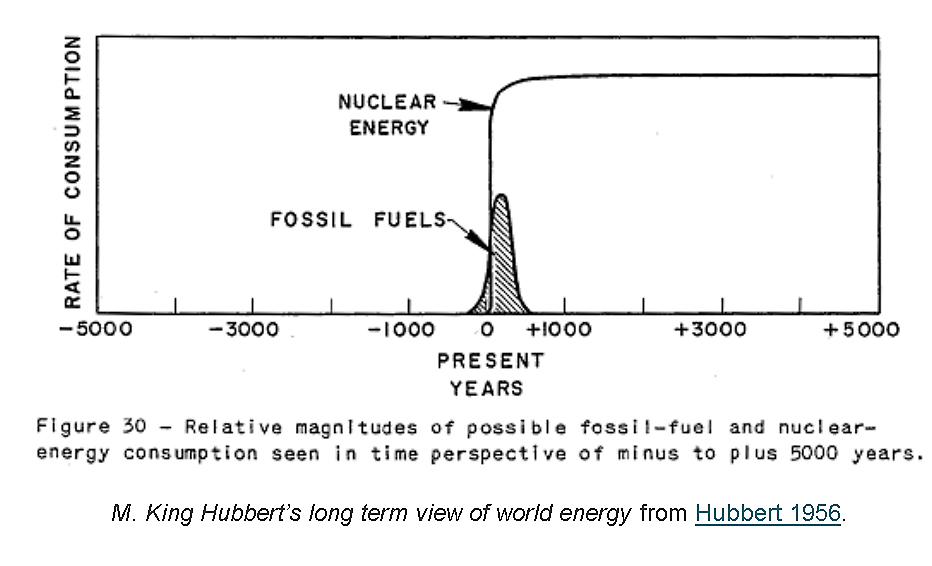

Hubbert was concerned with running out
of fossil fuel - not with creating a "Greenhouse Effect" out of the atmosphere.
But he did point out the relative difference in the amounts of energy available
from both fossil and nuclear fuels.


https://www.ltbridge.com/lightbridge-fuel
See Also:
https://www.deepisolation.com/
Mankind is the only animal able to light
a fire to avoid freezing to death and to cook his food to expand what is on the
menu.
The energy of choice depends on the availability and applicability of the
energies at hand and range from easy-to-obtain-and-use-wood to
very-difficult-to-use-uranium-from-seawater.
With so much non-climate
changing energy available at such low cost it would be foolish for us to turn our backs on it
because it is not yet quite perfect.
See Also:
https://www.bayotech.us/products-2
Please look again at how much uranium
mankind has available. So much uranium is available there is absolutely no reason to
recycle spent nuclear fuel waste into bombs.
Spent uranium must be buried irretrievably immediately. In WWII, the
United States used spent uranium to easily and quickly make the plutonium
nuclear bomb used on Nagasaki.
This should be a warning to us to never allow plutonium to get loose.
Once through and then
Subduction Disposal for nuclear.
Since all uranium used as nuclear fuel has some plutonium
bred in it during the process, it
must be disposed of immediately.
Bury It In A Subduction Zone And You'll
Never Get It Back. Also the deep borehole disposal.
https://en.wikipedia.org/wiki/Deep_borehole_disposal
_______________________________________________________________________________________________________________________________________________________________
Nuclear
Proliferation
The necessity for uranium enrichment for Light Water Reactors
and the presence of
plutonium in the spent fuel are
the primary proliferation concerns.
There are differing national policies for the use or storage of
fissile plutonium in the spent fuel, with some nations
electing to recycle plutonium
for use in new fuels
and others electing to leave it intact within
the spent fuel (IAEA, 2008a). The
presence of plutonium and minor
actinides in the
spent fuel leads to greater waste-disposal challenges
as well. Heavy isotopes such as plutonium and minor actinides have
very long half-lives, as high as tens to hundreds of
thousands of years
(NRC, 1996), which require final
waste-disposal strategies to address
safety of waste
disposal on such great timescales. Alternative strategies
to isolate and dispose of fission products and their
components
apart from actinides could have
significant beneficial impact on waste
disposal
requirements (Wigeland et al., 2006). Others have argued
that
separation and transmutation of actinides would
have little or no practical
benefit for waste
disposal (NRC, 1996; Bunn et al., 2003).
Alternative nuclear fuel cycles, beyond the once-through uranium
cycle, and related reactor technologies are under
investigation. Partial
recycling of used fuels, such
as the use of mixed-oxide (MOX)
fuels where U-235 in
enriched uranium fuel is replaced with recycled
or
excess plutonium, is utilized in some nations to improve uranium
resource utilization and waste-minimization efforts (OECD
and NEA,
2007; World Nuclear Association, 2013).
The thorium fuel cycle is an
alternative to the uranium fuel cycle, and the abundance of
thorium
resources motivates its potential use (see
Section 7.4.3). Unlike natural
uranium, however,
thorium does not contain any fissile isotopes. An
external source of fissile material is necessary to initiate the thorium
fuel cycle, and breeding of fissile U-233 from fertile
Th-232 is necessary
to sustain the fuel cycle (IAEA,
2005b).
Ultimately, full recycling options based on either uranium or
thorium fuel cycles that are combined with advanced reactor
designs — including
fast and thermal neutron spectrum
reactors — where only fission
products are relegated
as waste can significantly extend nuclear
resources
and reduce high-level wastes (GIF, 2002, 2009; IAEA, 2005b).
Current drawbacks include higher economic costs, as well as
increased
complexities and the associated risks of
advanced fuel cycles and reactor
technologies.
Potential access to fissile materials from widespread
application of reprocessing technologies further raises proliferation
concerns. The advantages and disadvantages of alternative
reprocessing
technologies are under investigation.
- from Energy Systems Chapter 7 - IPCC 5 - IPCC Working Group III - 2014.
Please visit:
https://www.deepisolation.com/
https://www.theatlantic.com/magazine/archive/1996/10/the-sub-seabed-solution/308434/
Sub-Seabed Nuclear Waste Disposal in Stable Clay Formations.pdf

Once through and then
Subduction disposal.
Since all uranium used as nuclear fuel has some plutonium
bred in it during the process, it
must be disposed of immediately.
Bury It In A Subduction Zone And You'll
Never Get It Back.
https://en.wikipedia.org/wiki/Deep_borehole_disposal
https://www.deepisolation.com/
_______________________________________________________________________________________________________________________________________________________________
Comment:
This website author, (jph), would like to point out
that by using only proven materials and technologies in their reactor, the
Nuclear Regulatory Commission Approved NuScale reactor is good to go now, not years
from now.
Easy-to-save reference for getting up to speed on modern nuclear power plants:
https://nuclearinnovationalliance.org/advanced-nuclear-reactor-technology-primer
(pdf)

_______________________________________________________________________________________________________________________________________________________________


This does not include tiny university materials research and nuclear medicine
production reactors.
Proliferation
Our initial fuel enrichment is 15-20%, making it the lowest strategic
value for proliferation potential. Lightbridge Fuel™ contains
significantly less plutonium than conventional uranium oxide fuel and
consumes more uranium during its operating cycle. Any plutonium in our
spent fuel is “useless” for nuclear weapons, according to an April 2018
issue of Nuclear Engineering and Design.
Abstract
Achieving a proliferation resistant, or possibly even
proliferation proof, plutonium is a goal of the nuclear security and
safeguards community. Considering that nearly all plutonium is under
international safeguards, with the exception of plutonium with greater
than 80 at.% 238Pu, reducing the necessity of these
safeguards would be beneficial to both those in industry and in national
and international security. Due to the 238Pu high decay heat,
establishing a technical limit for 238Pu content in which
rendering the plutonium useless for weapons purposes may be possible.
Following the analysis done by Kessler, the authors analyzed two
realistic models for hypothetical nuclear explosive devices seeking to
establish this technical limit for 238Pu content. The given
plutonium vector used for this analysis was obtained through simulations
of the Lightbridge fuel design in a pressurized water reactor.
Calculating the temperature profile within the two hypothetical nuclear
explosive device models showed that this plutonium vector would render
the two models useless by causing the high explosives to undergo
self-explosion.
Lightbridge Sets Priorities for SMR Fuel Development
Lightbridge Corporation (NASDAQ:LBTR)
has
decided to prioritize developing fuel for future small modular reactors
rather than fuel for large reactor designs, President and CEO Seth Grae said
this week in a business update ahead of a webcast and conference call to discuss
the company’s financial results.
_______________________________________________________________________________________________________________________________________________________________
Manufacturing Hydrogen Gas At A Nuclear
Electricity Plant That Has A Steam-for-Hydrogen
Capability
A Nuclear
Powered 90%+
Efficient Solid State Hydrogen Electrolyzer


Haldor Topsoe's above 90% efficient solid
state electrolyzer.
Hydrogen Electrolyzers can be nuclear powered to make massive amounts of
cheap hydrogen for the planned future clean combustion energy fuels. (Click
to Enlarge)
A Steam
Electrolysis Hydrogen Plant

Steam Electrolysis Hydrogen Plant for
mass production of hydrogen from electricity and water.
(Photo of a German plant.)
_______________________________________________________________________________________________________________________________________________________________
There Are Many Sources Of
Hydrogen


Hydrogen - Data telling a story
The many aspects of the gas Hydrogen - our future
replacement substance for fossil fuels like Natural Gas, Gasoline, Jet fuel, and
Diesel. Click to enlarge.
_______________________________________________________________________________________________________________________________________________________________
A Proposed
Deeply Decarbonized Electricity & Hydrogen Transportation Economy

_______________________________________________________________________________________________________________________________________________________________
_______________________________________________________________________________________________________________________________________________________________
https://www.paloverde.com/
The US Department of Energy (DOE) is
awarding $20 million in funding to a project to demonstrate technology
that will produce clean hydrogen energy from nuclear power. This approach
will allow clean hydrogen to serve as a source for zero-carbon electricity
and represent an important economic product for nuclear plants beyond
electricity.
The project, based in Arizona, will make progress on DOE’s H2@Scale
vision for clean hydrogen across multiple sectors and help meet the
Department’s Hydrogen Shot goal of $1 per 1 kilogram in one decade.
The project, led by PNW Hydrogen LLC, will receive $12 million from the
DOE’s Hydrogen and Fuel Cell Technologies Office (HFTO) and $8 million from
DOE’s Office of Nuclear Energy (NE) for a total award of $20 million. The
project will produce clean hydrogen from nuclear power at the
Palo Verde Nuclear Generating Station
in Phoenix, Arizona—the largest nuclear plant and the single-largest
generator of carbon-free electricity in the US.
Six tonnes of stored hydrogen will be used to produce approximately 200
MWh electricity during times of high demand, and may be also used to make
chemicals and other fuels. The project will provide insights about
integrating nuclear energy with hydrogen production technologies and inform
future clean hydrogen production deployments at scale.
PNW Hydrogen, LLC will be the primary recipient of the DOE award and will
collaborate with multiple stakeholders in research, academia, industry and
state-level government including Idaho National Laboratory, National Energy
Technology Laboratory, National Renewable Energy Laboratory, OxEon, Electric
Power Research Institute, Arizona State University, University of California
Irvine, Siemens, Xcel Energy, Energy Harbor and the LA Department of Water
and Power.
_______________________________________________________________________________________________________________________________________________________________
Facts about Topsoe’s large-scale SOEC manufacturing facility
- The
facility will have an electrolyzer production capacity of 500 MW per year,
expandable to 5GW
- Product
will be industrial-scale electrolyzers based on Topsoe’s proprietary
high-temperature electrolysis SOEC technology offering 30% larger hydrogen
output compared to standard technology such as PEM and alkaline
electrolysis.
-
Operational by 2023.
Selected projects with Topsoe’s technology
_______________________________________________________________________________________________________________________________________________________________
Nuclear
Water
Recycling
+
Desalination


_______________________________________________________________________________________________________________________________________________________________
Electricity
&
Hydrogen Nuclear Plants can have "Day/Night" Complimentary Loads
(Because you can store the hydrogen you are making until you
have accumulated enough to sell.)

_______________________________________________________________________________________________________________________________________________________________
A Natural
Gas Turbine Site
Is A Good Place To Build A NuScale Nuclear Plant
Combined cycle natural gas turbines look like a good idea to fill in for wind farm electricity
irregularities.


It's best to build new adjacent nuclear while old gas
turbine plants
are still
in service. Well-maintained original gas turbine facilities make excellent
quick-start stand-by power plants.
Unexpectedly large future loads such as large night time electric car battery
recharging and extreme night air conditioning loads
might throw a monkey wrench into plans for scrapping out CO2-producing
natural gas electricity generating facilities.
Also:
https://world-nuclear-news.org/Articles/Chinas-HTR-PM-reactor-achieves-first-criticality
A "Nuke Next Door" reactor hot enough to directly replace the coal section of a
power plant.
_______________________________________________________________________________________________________________________________________________________________
The
Best Way To Get A "Running Start" Is To Build Adjacent On An Existing
Coal Power Plant Site
We are going to need a small nuclear
power plant on almost every shut-down coal or gas power plant site everywhere in
the world.
TVA CEO: Utility Will Invest in SMRs

According to wire service reports, TVA President and CEO
Jeff Lyash said last week during an online
energy conference hosted by the Atlantic Council that to reach the 100%
reduction goal, the utility will need technological advances in energy storage,
carbon capture and small modular nuclear reactors. (YouTube
video) Lyash said TVA is on track to reduce greenhouse gas emissions by 80%
by the year 2035.
Coal Plants Converted to SMRs?
Lyash said that the hundreds of shuttered US coal power plants could be
repurposed as small nuclear reactor sites citing easy access to water resources
and existing power grid connections. “I see those sites as very viable small
modular reactor (SMR) sites.”
Lyash does not see coal as part of the utility’s future, saying TVA will
continue to phase it out over the next 15 years because its coal plants are
reaching the end of their lives.
Sen. Joe Manchin, D-W.Va., who also attended the virtual meeting, agreed,
“You could come online much quicker and we could accomplish this at a much
faster rate than anything else we could do.”
“Some of our better manufacturing sites are the coal-fired power plants,”
said Senator Joe Manchin, a Democrat from West Virginia. “You could come online
much quicker and we could accomplish this at a much faster rate than anything
else we could do,” he said about the SMR potential. - - -
_______________________________________________________________________________________________________________________________________________________________
The Cost Of
Various Types Of Reactors and Uranium
Actually, nuclear power is safer, environmentally
cleaner, and cheaper than all other forms of commercial energy.


_______________________________________________________________________________________________________________________________________________________________


Here, corn is used as feedstock for
fermenting ethanol to increase the octane of unleaded gasoline.
Massive amounts of biofuels massively drive up the cost of human fuels such as
corn - as shown in this example.
It's morally wrong for humans to have to compete with machines for energy.
_______________________________________________________________________________________________________________________________________________________________
_______________________________________________________________________________________________________________________________________________________________
The Safety
Perimeters of Small Modular Reactors are tiny compared with a conventional huge
reactor


Better to grab a Cat than a Tiger by the
tail.
NuScale & UAMPS (Utah Associated Municipal Power
Systems) Take Next Steps to License, Manufacture, and Build the
First of 12 SMRs
NuScale Power has gotten the go ahead to prepare a Combined License
Application (COLA) to be submitted to the Nuclear Regulatory Commission. The
UAMPS COLA is expected to be submitted to
the Nuclear Regulatory Commission (NRC) by the second quarter of 2023.
NRC review of the COLA is expected to be completed by the second half of
2025, with reactor construction of the project beginning shortly thereafter.
NuScale expects to have the first of 8 units in revenue service before the end
of the decade. Eventually, plans are for the site to have 12 SMRs. The power
rating of the site is a work in progress as NuScale started with an estimate of
50 MWE, but has since increased its design objective to 60 MWe and indicated it
has plans for 77 MWe.
The NuScale reference power plant can house up to 12 NuScale Power Modules
for a total facility output of 924 megawatts of electricity (MWe). NuScale also
offers smaller power plant solutions in 4-module and 6-module sizes with outputs
of 308 MWe (gross) and 462 MWe (gross), respectively. The multi-module NuScale
plant design is scalable, allowing customers to incrementally increase facility
output to match demand.
NuScale Power announced this week together with Utah Associated Municipal
Power Systems (UAMPS) that it has executed agreements to facilitate the
development of the Carbon Free Power Project (CFPP), which will deploy NuScale
Power Modules at the Idaho National Laboratory (INL).
Fluor Corporation and NuScale (as a subcontractor to Fluor) are to develop
higher maturity cost estimates and initial project planning work for the
licensing, manufacturing and construction of the CFPP.
_______________________________________________________________________________________________________________________________________________________________
NuScale's
Control Room Simulator

Control stations for 12 NuScale Reactor
Units. - Simple NuScale Reactor units need relatively fewer controls.
The NuScale reactor actually shares a critical thermodynamic feature
[convection water cooling] with the Ford Model T engine (October 1, 1908, to May
26, 1927).
_______________________________________________________________________________________________________________________________________________________________
How Soon?
Technology Readiness Levels for
these new thermal technologies.
The NuScale, Lightbridge, and
Carbon Engineering products have been approved by the U.S. Government.
At this time, CarbFix is non-mandatory.
The Class VI CO2
Disposal Well is a U.S. Government Design for an environmentally approvable
disposal license.
These 'Cooling the Planet'
technologies are of little or no value until Rolling Back Climate Change Part
1: DECARBONIZATION (i.e., Net-Zero) has been achieved.
_______________________________________________________________________________________________________________________________________________________________
About the Easy-to-Use Combustion Fuels:
Their Different Hydrogen-to-Carbon Ratios

Different fossil fuels make different amounts of
CO2 for
the same amount of heat (BTUs)

_______________________________________________________________________________________________________________________________________________________________
Cost and
Capacity Factors are the Keys to Enabling Decarbonization Of Energy
TO BE PART OF YOUR LIFE, ENERGY HAS TO BE DISPATCHABLE and NON-INTERMITTENT
(I.e., as much as you need, when you need
it.)


Cost and Capacity Factors are
the Keys to Converting to Hydrogen-driven Decarbonization

Electricity Risk Assessment - Click to
Enlarge.
_______________________________________________________________________________________________________________________________________________________________
_______________________________________________________________________________________________________________________________________________________________
_______________________________________________________________________________________________________________________________________________________________
_______________________________________________________________________________________________________________________________________________________________
The United States has largely phased out
it's coal power plants, replacing them with hundreds of small, cleaner, natural
gas turbine power plants located nearer to their customers to increase
electricity transmission
reliability.
The world has irrevocably committed itself to a dispatchable electricity &
hydrogen powered modern civilization. Only nuclear electricity generation
everywhere can satisfy such an energy demand safely on a forever basis.
https://energy-transitions.org/wp-content/uploads/2021/04/ETC-Global-Hydrogen-Report.pdf
-
https://www.iea.org/ , and
https://www.irena.org/
The group of 20 major industrialized
countries have directed nearly $300 billion in new funds toward continued fossil
fuel activities since the beginning of the COVID-19 pandemic
— far more than they have toward clean energy efforts.
It has become obvious we all must upgrade
our CO2-emitting natural gas turbine power plant sites
with more powerful, zero-CO2, SMALL MODULAR NUCLEAR REACTORS (SMRs).
Nuclear
Electricity + Steam for Hydrogen and/or Water Desalination

The stone-simple gravity-circulation NuScale Modular
Nuclear Reactor Power Plant is a very safe design to install co-located next to
our natural gas combustion turbine plant sites.
The reasons for this choice include access to the electrical grid, roads, rail,
workforce, and community acceptance.
With a full complement of 12 reactor modules, it will produce 924 megaWatts of
electricity, almost twice the power of the coal and/or natural gas turbine
power plants it is designed to replace.
https://www.youtube.com/watch?v=r1tK73l9Nbo Consider
the repowering of a worn-out coal power plant with a new nuclear reactor approach:
https://www.terrapraxis.org/about/about-us
https://www.science.org/news/2019/02/smaller-safer-cheaper-one-company-aims-reinvent-nuclear-reactor-and-save-warming-planet
https://www.getintonuclear.com/
In some ways, Greenies are like anti-vaxxers.
If Greenies were reasonable, there would be a NuScale nuclear power plant near
any U.S. town that could make good use of that much electricity.
_______________________________________________________________________________________________________________________________________________________________
Co-locating
Electricity & Hydrogen Modular Nuclear Power Plant Sites Next To Natural Gas Turbine Sites

It's best to build new adjacent nuclear while the old gas
turbine plant is still
in service. Well-maintained original gas turbine facilities make excellent
quick-start stand-by power plants.
Unexpectedly large future loads such as large night time electric car battery
recharging and extreme night air conditioning loads
might throw a monkey wrench into plans for scrapping out CO2-producing
natural gas electricity generating facilities.
Also:
https://world-nuclear-news.org/Articles/Chinas-HTR-PM-reactor-achieves-first-criticality
A "Nuke Next Door" reactor hot enough to directly replace the coal section of a
power plant.
_______________________________________________________________________________________________________________________________________________________________
The
Relative Amounts Of Energy Sources Available And How They Are Being Used

Mankind is the only animal able to
enlist external energy sources to better his life situations, i.e., such as
lighting a fire to avoid freezing to death.
The energy of choice depends on the availability and applicability of the
energies at hand and range from easy-to-obtain-and-use-wood to
very-difficult-uranium-from-seawater.
Please look again at how much uranium
mankind has available. So much uranium is available there is absolutely no reason to
recycle spent nuclear fuel waste.
Spent uranium must be buried irretrievably immediately. In WWII, the
United States used spent uranium to easily and quickly make the plutonium
nuclear bomb used on Nagasaki.
Once through and then
Subduction Disposal for nuclear.
Since all uranium used as nuclear fuel has some plutonium
bred in it during the process, it
must be disposed of immediately.
Bury It In A Subduction Zone And You'll
Never Get It Back.
https://en.wikipedia.org/wiki/Deep_borehole_disposal
Comment:
This website author, (jph), would like to point out
that by using only proven materials and technologies in their reactor, the
Nuclear Regulatory Commission Approved NuScale is good to go now, not years
from now.
Easy-to-save reference for getting up to speed on modern nuclear power plants:
https://nuclearinnovationalliance.org/advanced-nuclear-reactor-technology-primer
(pdf)
_______________________________________________________________________________________________________________________________________________________________
The World
Now Has A Melt-Down-Proof Nuclear Fuel Rod
that can be used to replace old-fashioned fuel rods
for improved reactor performance.
https://www.ltbridge.com/lightbridge-fuel
See Also:
https://www.deepisolation.com/
Lightbridge claims much better safety.
refueling intervals, and power output on existing water-cooled reactors than
obtainable from the traditional 77 year-old fuel rod design.
This does not include tiny university materials research and nuclear medicine
production reactors.
Proliferation
Our initial fuel enrichment is 15-20%, making it the lowest strategic
value for proliferation potential. Lightbridge Fuel™ contains
significantly less plutonium than conventional uranium oxide fuel and
consumes more uranium during its operating cycle. Any plutonium in our
spent fuel is “useless” for nuclear weapons, according to an April 2018
issue of Nuclear Engineering and Design.
Abstract
Achieving a proliferation resistant, or possibly even
proliferation proof, plutonium is a goal of the nuclear security and
safeguards community. Considering that nearly all plutonium is under
international safeguards, with the exception of plutonium with greater
than 80 at.% 238Pu, reducing the necessity of these
safeguards would be beneficial to both those in industry and in national
and international security. Due to the 238Pu high decay heat,
establishing a technical limit for 238Pu content in which
rendering the plutonium useless for weapons purposes may be possible.
Following the analysis done by Kessler, the authors analyzed two
realistic models for hypothetical nuclear explosive devices seeking to
establish this technical limit for 238Pu content. The given
plutonium vector used for this analysis was obtained through simulations
of the Lightbridge fuel design in a pressurized water reactor.
Calculating the temperature profile within the two hypothetical nuclear
explosive device models showed that this plutonium vector would render
the two models useless by causing the high explosives to undergo
self-explosion.
Lightbridge Sets Priorities for SMR Fuel Development
Lightbridge Corporation (NASDAQ:LBTR)
has
decided to prioritize developing fuel for future small modular reactors
rather than fuel for large reactor designs, President and CEO Seth Grae said
this week in a business update ahead of a webcast and conference call to discuss
the company’s financial results.
_______________________________________________________________________________________________________________________________________________________________
Manufacturing Hydrogen Gas At A Nuclear
Electricity Plant That Has A Steam-for-Hydrogen
Capability
A Nuclear
Powered 90%+
Efficient Solid State Hydrogen Electrolyzer
Haldor Topsoe's above 90% efficient solid
state electrolyzer.
Hydrogen Electrolyzers can be nuclear powered to make massive amounts of
cheap hydrogen for the planned future clean combustion energy fuels. (Click
to Enlarge)
A Steam
Electrolysis Hydrogen Plant
Steam Electrolysis Hydrogen Plant for
mass production of hydrogen from electricity and water.
(Photo of a German plant.)
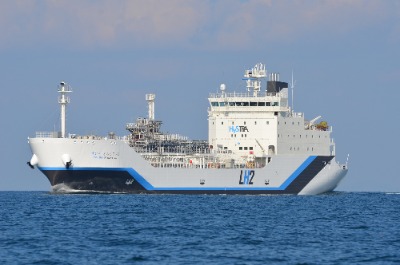
This vessel was developed to provide a
means of transporting liquefied hydrogen at 1/800 of its original gas-state
volume, cooled to –253°C, safely and in large quantities over long distances by
sea.
The vessel can carry 75 tonnes of liquefied hydrogen in one trip. With the goal
of making hydrogen just as common a fuel source as petroleum and natural gas,
Kawasaki joined together in 2016 with Iwatani Corporation (Iwatani), Shell Japan
Limited, and Electric Power Development Co., Ltd. (J-POWER) to form the CO2-free
Hydrogen Energy Supply-chain Technology Research Association (HySTRA).
There Are Many Sources Of
Hydrogen
Hydrogen - Data telling a story
The many aspects of the gas Hydrogen - our future
replacement substance for fossil fuels like Natural Gas, Gasoline, Jet fuel, and
Diesel. Click to enlarge.
_______________________________________________________________________________________________________________________________________________________________
https://www.paloverde.com/
The US Department of Energy (DOE) is
awarding $20 million in funding to a project to demonstrate technology
that will produce clean hydrogen energy from nuclear power. This approach
will allow clean hydrogen to serve as a source for zero-carbon electricity
and represent an important economic product for nuclear plants beyond
electricity.
The project, based in Arizona, will make progress on DOE’s H2@Scale
vision for clean hydrogen across multiple sectors and help meet the
Department’s Hydrogen Shot goal of $1 per 1 kilogram in one decade.
The project, led by PNW Hydrogen LLC, will receive $12 million from the
DOE’s Hydrogen and Fuel Cell Technologies Office (HFTO) and $8 million from
DOE’s Office of Nuclear Energy (NE) for a total award of $20 million. The
project will produce clean hydrogen from nuclear power at the
Palo Verde Nuclear Generating Station
in Phoenix, Arizona—the largest nuclear plant and the single-largest
generator of carbon-free electricity in the US.
Six tonnes of stored hydrogen will be used to produce approximately 200
MWh electricity during times of high demand, and may be also used to make
chemicals and other fuels. The project will provide insights about
integrating nuclear energy with hydrogen production technologies and inform
future clean hydrogen production deployments at scale.
PNW Hydrogen, LLC will be the primary recipient of the DOE award and will
collaborate with multiple stakeholders in research, academia, industry and
state-level government including Idaho National Laboratory, National Energy
Technology Laboratory, National Renewable Energy Laboratory, OxEon, Electric
Power Research Institute, Arizona State University, University of California
Irvine, Siemens, Xcel Energy, Energy Harbor and the LA Department of Water
and Power.
_______________________________________________________________________________________________________________________________________________________________
Facts about Topsoe’s large-scale SOEC manufacturing facility
- The
facility will have an electrolyzer production capacity of 500 MW per year,
expandable to 5GW
- Product
will be industrial-scale electrolyzers based on Topsoe’s proprietary
high-temperature electrolysis SOEC technology offering 30% larger hydrogen
output compared to standard technology such as PEM and alkaline
electrolysis.
-
Operational by 2023.
Selected projects with Topsoe’s technology
_______________________________________________________________________________________________________________________________________________________________
Electricity
&
Hydrogen Nuclear Plants can have "Day/Night" Complimentary Loads
(Because you can store the hydrogen you are making until you
have accumulated enough to sell.)
_______________________________________________________________________________________________________________________________________________________________
A Proposed
Deeply Decarbonized Electricity & Hydrogen Transportation Economy
See Also:
https://www.bayotech.us/products-2
_______________________________________________________________________________________________________________________________________________________________
The
Best Way To Get A "Running Start" Is To Build Adjacent On An Existing
Coal Power Plant Site
We are going to need a small nuclear
power plant on almost every shut-down coal or gas power plant site everywhere in
the world.
TVA CEO: Utility Will Invest in SMRs
According to wire service reports, TVA President and CEO
Jeff Lyash said last week during an online
energy conference hosted by the Atlantic Council that to reach the 100%
reduction goal, the utility will need technological advances in energy storage,
carbon capture and small modular nuclear reactors. (YouTube
video) Lyash said TVA is on track to reduce greenhouse gas emissions by 80%
by the year 2035.
Coal Plants Converted to SMRs?
Lyash said that the hundreds of shuttered US coal power plants could be
repurposed as small nuclear reactor sites citing easy access to water resources
and existing power grid connections. “I see those sites as very viable small
modular reactor (SMR) sites.”
Lyash does not see coal as part of the utility’s future, saying TVA will
continue to phase it out over the next 15 years because its coal plants are
reaching the end of their lives.
Sen. Joe Manchin, D-W.Va., who also attended the virtual meeting, agreed,
“You could come online much quicker and we could accomplish this at a much
faster rate than anything else we could do.”
“Some of our better manufacturing sites are the coal-fired power plants,”
said Senator Joe Manchin, a Democrat from West Virginia. “You could come online
much quicker and we could accomplish this at a much faster rate than anything
else we could do,” he said about the SMR potential. - - -
_______________________________________________________________________________________________________________________________________________________________
The Cost Of
Various Types Of Reactors and Uranium
Actually, nuclear power is safer, environmentally
cleaner, and cheaper than all other forms of commercial energy.
_______________________________________________________________________________________________________________________________________________________________
Here, corn is used as feedstock for
fermenting ethanol to increase the octane of unleaded gasoline.
Massive amounts of biofuels massively drive up the cost of human fuels such as
corn - as shown in this example.
It's morally wrong for humans to have to compete with machines for energy.
_______________________________________________________________________________________________________________________________________________________________
Nuclear
Proliferation
The necessity for uranium enrichment for Light Water Reactors
and the presence of plutonium in the spent fuel are
the primary proliferation concerns.
There are differing national policies for the use or storage of
fissile plutonium in the spent fuel, with some nations
electing to recycle plutonium for use in new fuels
and others electing to leave it intact withinthe spent fuel (IAEA, 2008a). The
presence of plutonium and minor actinides in the
spent fuel leads to greater waste-disposal challenges
as well. Heavy isotopes such as plutonium and minor actinides have
very long half-lives, as high as tens to hundreds of
thousands of years (NRC, 1996), which require final
waste-disposal strategies to address safety of waste
disposal on such great timescales. Alternative strategies
to isolate and dispose of fission products and their
components apart from actinides could have
significant beneficial impact on waste disposal
requirements (Wigeland et al., 2006). Others have argued
that separation and transmutation of actinides would
have little or no practical benefit for waste
disposal (NRC, 1996; Bunn et al., 2003).
Alternative nuclear fuel cycles, beyond the once-through uranium
cycle, and related reactor technologies are under
investigation. Partial recycling of used fuels, such
as the use of mixed-oxide (MOX) fuels where U-235 in
enriched uranium fuel is replaced with recycled or
excess plutonium, is utilized in some nations to improve uranium
resource utilization and waste-minimization efforts (OECD
and NEA, 2007; World Nuclear Association, 2013).
The thorium fuel cycle is an
alternative to the uranium fuel cycle, and the abundance of
thorium resources motivates its potential use (see
Section 7.4.3). Unlike natural uranium, however,
thorium does not contain any fissile isotopes. An
external source of fissile material is necessary to initiate the thorium
fuel cycle, and breeding of fissile U-233 from fertile
Th-232 is necessary to sustain the fuel cycle (IAEA,
2005b).
Ultimately, full recycling options based on either uranium or
thorium fuel cycles that are combined with advanced reactor
designs — including fast and thermal neutron spectrum
reactors — where only fission products are relegated
as waste can significantly extend nuclear resources
and reduce high-level wastes (GIF, 2002, 2009; IAEA, 2005b).
Current drawbacks include higher economic costs, as well as
increased complexities and the associated risks of
advanced fuel cycles and reactor technologies.
Potential access to fissile materials from widespread
application of reprocessing technologies further raises proliferation
concerns. The advantages and disadvantages of alternative
reprocessing technologies are under investigation.
- from Energy Systems Chapter 7 - IPCC 5 - IPCC Working Group III - 2014.
Please visit:
https://www.deepisolation.com/
https://www.theatlantic.com/magazine/archive/1996/10/the-sub-seabed-solution/308434/
Sub-Seabed Nuclear Waste Disposal in Stable Clay Formations.pdf
Once through and then
Subduction disposal.
Since ALL uranium used for nuclear fuel has bred some plutonium in it, it
must be disposed of. Bury It In A Subduction Zone And You'll
Never Get It Back.
Since all uranium used as nuclear fuel has some plutonium
bred in it during the process, it
must be disposed of immediately.
Bury It In A Subduction Zone And You'll
Never Get It Back.
https://en.wikipedia.org/wiki/Deep_borehole_disposal
https://www.deepisolation.com/
_______________________________________________________________________________________________________________________________________________________________
The Safety
Perimeters of Small Modular Reactors are tiny compared with a conventional huge
reactor
Better to grab a Cat than a Tiger by the
tail.
NuScale & UAMPS (Utah Associated Municipal Power
Systems) Take Next Steps to License, Manufacture, and Build the
First of 12 SMRs
NuScale Power has gotten the go ahead to prepare a Combined License
Application (COLA) to be submitted to the Nuclear Regulatory Commission. The
UAMPS COLA is expected to be submitted to
the Nuclear Regulatory Commission (NRC) by the second quarter of 2023.
NRC review of the COLA is expected to be completed by the second half of
2025, with reactor construction of the project beginning shortly thereafter.
NuScale expects to have the first of 8 units in revenue service before the end
of the decade. Eventually, plans are for the site to have 12 SMRs. The power
rating of the site is a work in progress as NuScale started with an estimate of
50 MWE, but has since increased its design objective to 60 MWe and indicated it
has plans for 77 MWe.
The NuScale reference power plant can house up to 12 NuScale Power Modules
for a total facility output of 924 megawatts of electricity (MWe). NuScale also
offers smaller power plant solutions in 4-module and 6-module sizes with outputs
of 308 MWe (gross) and 462 MWe (gross), respectively. The multi-module NuScale
plant design is scalable, allowing customers to incrementally increase facility
output to match demand.
NuScale Power announced this week together with Utah Associated Municipal
Power Systems (UAMPS) that it has executed agreements to facilitate the
development of the Carbon Free Power Project (CFPP), which will deploy NuScale
Power Modules at the Idaho National Laboratory (INL).
Fluor Corporation and NuScale (as a subcontractor to Fluor) are to develop
higher maturity cost estimates and initial project planning work for the
licensing, manufacturing and construction of the CFPP.
_______________________________________________________________________________________________________________________________________________________________
NuScale's
Control Room Simulator
Control stations for 12 NuScale Reactor
Units. - Simple NuScale Reactor units need relatively fewer controls.
The NuScale reactor actually shares a critical thermodynamic feature
[convection water cooling] with the Ford Model T engine (October 1, 1908, to May
26, 1927).
_______________________________________________________________________________________________________________________________________________________________
How Soon?
Technology Readiness Levels for
these new thermal technologies.
The NuScale, Lightbridge, and
Carbon Engineering products have been approved by the U.S. Government.
At this time, CarbFix is non-mandatory.
The Class VI CO2
Disposal Well is a U.S. Government Design for an environmentally approvable
disposal license.
These 'Cooling the Planet'
technologies are of little or no value until Rolling Back Climate Change Part
1: DECARBONIZATION (i.e., Net-Zero) has been achieved.
_______________________________________________________________________________________________________________________________________________________________
About the Easy-to-Use Combustion Fuels:
Their Different Hydrogen-to-Carbon Ratios
Different fossil fuels make different amounts of
CO2 for
the same amount of heat (BTUs)
_______________________________________________________________________________________________________________________________________________________________
Cost and
Capacity Factors are the Keys to Enabling Decarbonization Of Energy
TO BE PART OF YOUR LIFE, ENERGY HAS TO BE DISPATCHABLE and NON-INTERMITTENT
(I.e., as much as you need, when you need
it.)
Cost and Capacity Factors are
the Keys to Converting to Hydrogen-driven Decarbonization
Electricity Risk Assessment - Click to
Enlarge.
_______________________________________________________________________________________________________________________________________________________________
It is time for the major developers of advanced nuclear reactors, and small
modular light water reactors, in the U.S. to support funding for the
Versatile Test Reactor (VTR).
The reason is that these firms will need its testing capabilities to
certify that their fuels, materials, sensors, and components will work in
the demanding conditions that these plants are designed to operate in.
There is no other way to do it. Self-certification either directly or
with fuel and component vendors, is not a viable strategy.
Real-time measurements and post-irradiation examination techniques will
provide valuable information on how fuels, materials, components and
instrumentation withstand the extreme conditions inside nuclear power
plants. This is crucial information needed to design, license, and build
successful implementations of advanced nuclear reactors."
_______________________________________________________________________________________________________________________________________________________________

