 Chapter
4: Electricity Decarbonization,
Recycling Coal Power Plants
Home Page Site Map (Contents & Chapters) Footnotes & Links
Air Contactor.com
Chapter
4: Electricity Decarbonization,
Recycling Coal Power Plants
Home Page
Site Map (Contents & Chapters)
Footnotes
& Links
Subject Index: Summary Introduction Chapter : The Power Plants Chapter Capturing The Carbon Dioxide (CO2) Emissions Chapter Using Michigan's Stranded Oil
Recycling Coal Power Plants

Coal Power Plant Shut-Downs
(Below) There are literally dozens of small coal power plants that have either been shut down or will be shut down soon. Some still have many useful years of electricity generation left in them. There is a path back to life for them.
All over the world there are thousands of depleted oil fields. The oldest ones ran out of oil over 150 years ago and were simply abandoned and forgotten. The lifecycle of an oil field frequently goes something like this: 1., About 30% of the oil is easy pumping. 2., About 30% of the oil in a now-depleted oil field can be flushed out using alternating solvent and water injection cycles from injection wells drilled around the edge of the oil field to push the remaining oil toward the oil pumps. 3., About 30% of the oil is too strongly attached to pores in the sand and cannot be extracted with today's technology.
This implies that there is as much oil still to be obtained from existing depleted oil fields as mankind has already obtained since the beginning of the age of oil. Carbon capture provides the key that can unlock that massive wealth of energy.

Global Locations of Depleted Oil Fields
One of the best solvents to flush oil out of a depleted oil field is liquid carbon dioxide (CO2).
Power generation jet engines are available that can deliver long service running on raw crude oil.
There are post-combustion carbon capture systems available that can capture over 90% of the carbon dioxide from the exhaust of crude oil burning jet engines. This amount of liquid CO2 is sufficient to power the crude oil burning jet engine in an endless circular CO2/oil/CO2/oil cycle.
This web page is about converting coal power power plants to carbon captured combined cycle power plants with crude oil burning jet engines supplying the heat to make the steam necessary to spin the the old coal power plant's electricity generating steam turbine.

Component Descriptions
________________________________________________________________
Combined cycle power plants are made worldwide by perhaps a dozen different power plant companies.
General Electric makes a very efficient
750 megaWatt combined cycle power plant called the "FlexEfficiency 60". Depending on details, they are usually installed and
on-line in 6 to 12 months.
A 750 megaWatt power plant's electricity wholesales to the grid for almost 1
million dollars a day. Think about what that does for the local economy.
For levelized cost comparisons of different types of power plants: https://en.wikipedia.org/wiki/Cost_of_electricity_by_source
3 times 750 mW would produce 2,250 megaWatts, bringing an end to Michigan's 2,233 mW electricity shortfall.
These units put out almost the same amount of electricity as a small nuclear plant and are "Dry", i.e., they don't need cooling ponds or rivers.

Usually made to burn natural gas, they can be equipped to burn oil instead - and Michigan is the U.S.' 17th largest oil producing state.
When burning biodiesel oil instead of fossil fuel oil, the FlexEfficiencies are considered by the Climate Change people to be "carbon neutral", meaning they neither add to, nor remove from, the air's Climate Changing carbon dioxide (CO2) pollution.
Oil instead of natural gas.
The easiest way to understand how
coal power plants work is to watch this 3 minute educational
video:
https://www.youtube.com/watch?v=GxHQHcpCWa8
The easiest way to understand how combined cycle power plants work is to watch this 3 minute educational video: https://www.youtube.com/watch?v=GWEG7_3RBA0
Oil's CO2 Is Halfway Between Coal and Natural Gas

By locating carbon-neutral manufacturing facilities on obsolete coal power plant sites, the local staff and all the access equipment could remain employed for a whole second career of making both larger quantities of electricity and large quantities of carbon-neutral syngas biosynfuels.
In South Central Michigan there are several such plants located near depleted oil fields that could be used to provide the necessary oil.
Initially, the obsolete coal power plant would have something like the combined cycle plant below added to it. Excess energy not used to power the carbon capturing equipment could be used to power the old electricity generator.

(Above) Combined Cycle Electricity Generation Plant with Integral Carbon Capture.

Post Combustion Carbon Capture process using an amine solvent to absorb (CO2 Absorber) and then reject (CO2 Stripper) the CO2 gas.


Incredibly, many small old coal power plants are located near depleted oil fields - an excellent place to salvage oil and to dispose of the CO2 burning of oil creates. Many states have similar 100+ year-old depleted oil fields, sometimes forgotten or unknown by inheritors of century old farms.
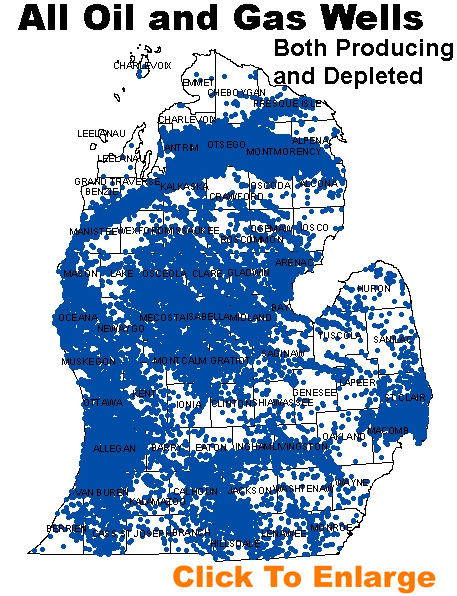
State records of depleted oil fields are well-mapped, showing locations of the wells - both producing and dry - greatly reducing the possibility of drilling a "dry" well. Short transportation distances for the oil to the carbon-neutral fuel plant and short distances for the CO2 to travel from the plant to the oil field to flush out more oil keep transportation and handling costs to a minimum. Often, old abandoned railroad right-of-way spur lines run to remote long-depleted oil boom fields - a clue for Google Earth users ferreting out forgotten depleted oil fields.
In many cases, it may be possible for the power company to purchase the mineral rights to nearby depleted oil fields at very advantageous prices because only the power company would have the captured carbon dioxide needed to flush more oil out of a depleted oil field. Current experience with using liquid carbon dioxide alternated with water as a flushing methodology on the Texas Permian Basin oil field has been very rewarding.
The now-unneeded coal power plant in this article, located in South Central Michigan, is a perfect candidate for upgrading to a site for manufacturing syngas biosynfuels.

________________________________________________________________
(Below) Using depleted oil energy to make synthetic carbon-neutral liquid biosynfuels for vehicle use. See >

________________________________________________________________
________________________________________________________________
12
Apart from tests, there have been in total 19 SGT-500 units running on crude oil or HFO,
totaling together more than 900 000 operation hours, and the high time unit has passed 90 000 hours of operation. Some of these units are operating continuously at full load (turbine inlet temp. 850 deg. C) with substantial dosing of chemical inhibitors for the high concentrations of heavy metals in the fuel, which increases the requirement for turbine cleaning. As a result of this, a special cleaning system and optimized off line washing procedure has been developed to remove deposits also in the power turbine. This off line cleaning can be synchronized with the off line washing of the compressors.It might be a surprise to some, but with correct fuel treatment and carefully performed
operational maintenance, including cleaning of the turbine section, the SGT-500 fleet that operates on crude and HFO achieves the availability and reliability at almost the same level as for the fleet that operates on natural gas or high quality liquid fuels. Typical figures for this fleet are 95% availability and 99% reliability. - Michael Welch, Siemens Industrial Turbomachinery Limited, United Kingdom