 2.
Nuclear Water Desalination and Nuclear Power
Front Page Prolog
SkyScrubber.com
2.
Nuclear Water Desalination and Nuclear Power
Front Page
Prolog
Nuclear Water Desalination and Nuclear Power
Introduction to this page:
What:
Where:
When:
Why:
How:
The nuclear industry is
making advances too:
https://www.deepisolation.com/
UofM School of Nuclear Engineering talk:
https://www.youtube.com/watch?v=2-lVPeTUEFg
Repairing the Water: A
Sustainable Future Also Demands Abundant Energy To Make
Fresh Water.
https://www.world-nuclear-news.org/Articles/Lightbridge-demonstrates-SMR-fuel-rod-manufacture
https://www.ltbridge.com/lightbridge-fuel
https://inis.iaea.org/collection/NCLCollectionStore/_Public/47/065/47065279.pdf
2.007.06
Energy, Water, and our Future
are Inextricably
Intertwined
80% of fresh water use is for
growing our food, 70% of desalination is for purifying brackish water.
The Mid-East has over 1,600 flash desalinator stages currently in service. They
are a well-developed technology.


Why don’t we get more
drinking water from desalinating the ocean?Peter H. Gleick,
president of the Pacific Institute, a nonprofit environmental and water policy think tank based in Oakland, Calif., distills an answer:The desalination of water requires a lot of energy and, hence,
money. The price varies widely from place to place, ranging from just under a dollar up to several dollars to produce a cubic meter (264 gallons) of desalted water, and efforts to reduce the energy requirements have not kept pace with rising energy costs. The cost of drawing freshwater from a river or aquifer is much lower— about 10 to 20 cents per cubic meter—and farmers often pay even less. As a result, desalination currently satisfies less than half a percent of human water needs. Desalination carries environmental costs as well: seawater intakes can suck up small ocean creatures, upsetting the food chain, and the process’s leftover brine is so strong that its return to the ocean can prove harmful to coastal ecosystems. Nevertheless, desalination’s appeal is growing as other sources of water disappear and the price gap closes. Finding a new source of freshwater or building a dam in a place such as California, for instance, can drive costs up to 60 cents per cubic meter. Far more must be done to use water more efficiently, but with the world’s population swelling and the water supply dwindling, the economic tide may soon turn in favor of desalination. ■
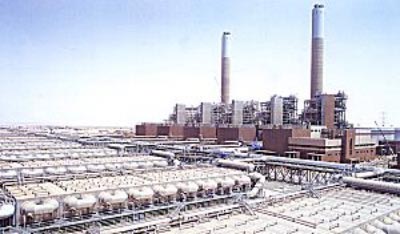
Saudi Arabia Shoaiba Unit 1 - An oil powered combined electricity power and flash desalination water plant.
________________________________________
_____________________________________________- Using Nuclear Energy to Repair Our Water Supplies -
The time has come where using fossil energy heat to desalinate a climate changing world's water is wrong.
INTEGRATION OF NUSCALE SMR WITH DESALINATION TECHNOLOGIES
D. T. Ingersoll
, NuScale Power, LLC, Corvallis, OR, USA, et al. Proceedings of the ASME 2014 Small Modular Reactors Symposium, SMR2014, April 15-17, 2014, Washington, D.C., USA. Note: Most of below images are from website author.ABSTRACT
Nuclear energy plants are attractive energy source
s for large scale water desalination since the thermal energy produced in a nuclear reactor can provide both electricity and steam to desalt water without the production of greenhouse gases. A particularly attractive option is to couple a desalination plant with the new generation of nuclear plant designs: small modular reactors (SMR). This allows regions with smaller electrical grids and limited infrastructure to add new electrical and water capacity in more appropriate increments and allows countries to consider siting plants at a broader range of distributed locations.The NuScale SMR plant design is especially well suited for the
co-generation of electricity and desalted water. The enhanced safety, improved affordability, and deployment flexibilities of the NuScale design provide a cost-effective approach to expanding global desalination capacity. Parametric studies have been performed to evaluate technical options for coupling a NuScale plant to a variety of different desalination technologies. An economic comparison of these options was performed for each of the different desalination technologies coupled to an appropriately sized NuScale plant capable of providing sufficient carbon-free electricity and clean water to support a city of 300,000 people.
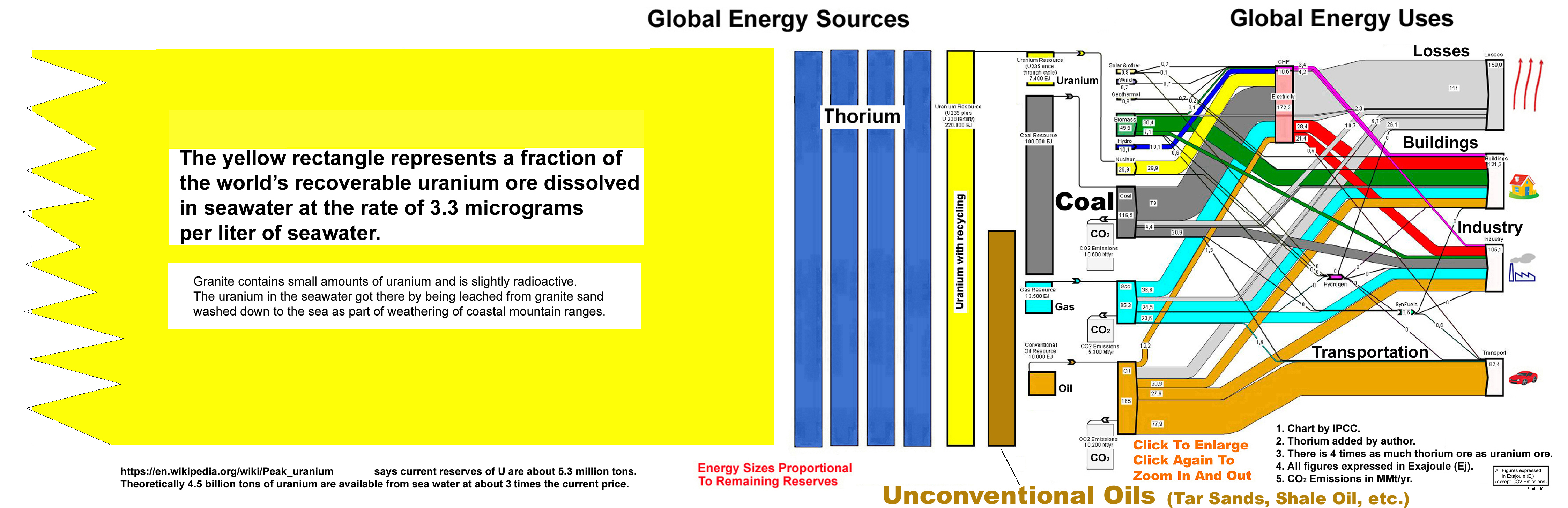
There is a staggering amount of much-cheaper-than-coal nuclear heat available for desalinating the oceans to obtain fresh water.

7 year membrane life.
Comparing "Multi-Stage Flash Desalinators" and "Reverse-Osmosis Desalinators".


Your website author is using Reverse-Osmosis desalinated water from the largest desalinator
facility
in the Western Hemisphere,
located just South of Tampa, Florida.
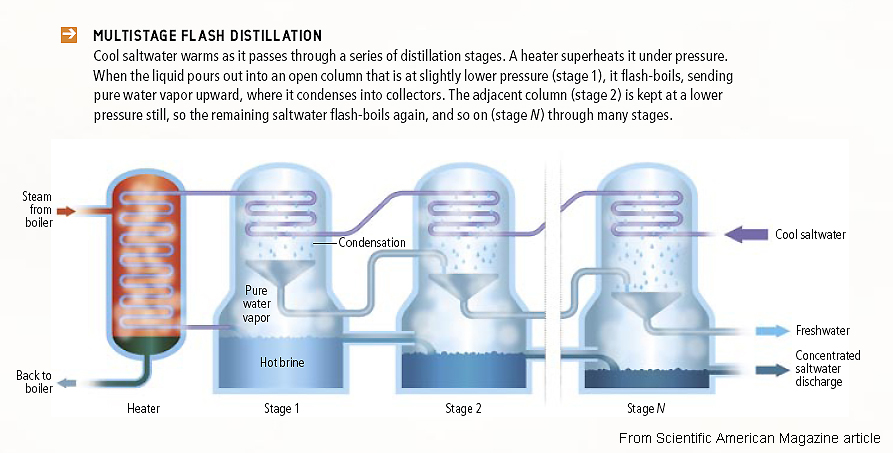
There are over 16,000 flash water desalinator
stages producing 75 million cubic meters of fresh water per day.
60% is seawater, but 35% is desalination of
brackish ground and surface water. Concentrated seawater gives you a head start
for extracting it's dissolved uranium using water softener ion-exchange
technology.
Japan holds all the key primary international patents for this process.
________________________________________
_____________________________________________
Nuclear Fission Water Desalination + Electricity Generation


Control stations for 12 NuScale Reactor Units. - Not completely unlike Henry Ford's Model T engine, the very simple NuScale Reactor units need relatively little in the way of controls.

Your web site author worked 1959 & 1960 as an electrical engineering intern making control room instrumentation installation diagrams for the Monroe, Michigan, Fermi I 69 megawatt (electrical) sodium fast fission reactor.
Integration of NuScale Small Modular Reactor (SMR) With Desalination Technologies
Note: The first operational
ultra-safe, inexpensive NuScale SMR has been under construction at Idaho
National Labs for about a year. It's power will go to the U.S. Pacific Northwest
Grid.
A NuScale reactor power plant can have as many as 12 reactor modules, starting
modestly but, over time, enabling a rather large city to have all the
electricity and desalinated water it needs.
Desalination is extremely energy-intensive but both the energy reserves - ocean's uranium - and ocean's saline water reserves - are vast.
________________________________________
_____________________________________________


Electricity Demand varies widely over both
the day and the year.
This means you can run the nuclear
reactor flat-out all the time, shifting between mostly electricity and mostly
water desalination every 24 hours, and just pump your extra water into a water reservoir
until needed.

________________________________________
_____________________________________________
Nuclear power plants
installed on barges can easily bring clean electricity
to the world's massive coastal populations, then return to shipyards for repair,
refueling.
Several countries already have nuclear power plant
barges in the works. China has an excellent model under development.


________________________________________
_____________________________________________